So this is it. The paperwork is done, all medical tests cleared, bags are packed and yes, I'm ready to go. Sunday, Inch'Allah, I will fly away. And I do say "Inch'Allah" not because I think that it won't happen, but because I really hope that it will. That all will go well, that I will leave roughly on time and arrive around time, make all my connections and get where I am going "in peace, all in one piece," as I have taken to praying every time I get into a shaky sept-place or public bus.
But I also believe, somehow, that even if I am late, if I end up paying an arm and a leg (and maybe a spare kidney) for my excess baggage, that I will, eventually, get home. That no matter what happens, from now on, I can deal with it. Because of what I have lived here, because of what I have learned here, I feel up to whatever comes next. So come Sunday I will still cross my fingers and say a little prayer, but I will also remember that whatever happens, it will all work out.
"How will it?" you might say.
I don't know. It's a mystery - but one that doesn't frighten me so much anymore.
NB: To those of you out there who read this, especially to those in particular who know who they are, please deploy your bubbles of security Sunday through Monday for me and my travel partner Diana, as even modern technology can use a little boost. Bu sobee Yalla (God willing) we will arrive, but I will travel a little easier knowing that bubble is out there. Merci mille fois, et en attendant de vous voir je vous embrasse tres fort!
Friday, May 21, 2010
Sunday, May 9, 2010
may you go in peace, and arrive in peace...
But the news is not all bad. So many people have wished me well these last few days, I feel the combined strength of their prayers propelling me on to finish my last tasks, motivating me to pack my bags, clean out my room and say my final goodbyes.
Friday my Senegalese mom Rama threw me a party at our house, and so many people came, I was overwhelmed. I had invited about thirty, people I have worked with mostly, a few friends and relatives of my family, and after I had wondered if anyone would show up at all, most of them came, and then a few more. A goat was killed in honor of the event, and the night before I helped Rama to cut up two big bowls of carrots and turnips to marinate for topping the rice and meat. Somehow as if by magic there was enough food for everyone who kept coming, one single bottle of Coke in the ice bucket at the end of the afternoon, and just enough meat and onions left over for Rama to make a pot of soup for a quiet dinner.
I spent most of the day on my feet, greeting and smiling and taking in the presence of all these people who had come to see me off. The last guest left after 6pm, and after pounding peppercorns for Rama's soup I got a warm bucket bath at 7, tired but happy.
Tonight is my last night in town, in my own bed, until I get back to the States in three weeks, bu sobee Yalla. I need to get back to the house now and sit a spell with my family, because tomorrow is goodbye.
To my family back home, I'm coming soon. Happy Mother's Day, Mom. I love you and can't wait to see you!
Friday my Senegalese mom Rama threw me a party at our house, and so many people came, I was overwhelmed. I had invited about thirty, people I have worked with mostly, a few friends and relatives of my family, and after I had wondered if anyone would show up at all, most of them came, and then a few more. A goat was killed in honor of the event, and the night before I helped Rama to cut up two big bowls of carrots and turnips to marinate for topping the rice and meat. Somehow as if by magic there was enough food for everyone who kept coming, one single bottle of Coke in the ice bucket at the end of the afternoon, and just enough meat and onions left over for Rama to make a pot of soup for a quiet dinner.
I spent most of the day on my feet, greeting and smiling and taking in the presence of all these people who had come to see me off. The last guest left after 6pm, and after pounding peppercorns for Rama's soup I got a warm bucket bath at 7, tired but happy.
Tonight is my last night in town, in my own bed, until I get back to the States in three weeks, bu sobee Yalla. I need to get back to the house now and sit a spell with my family, because tomorrow is goodbye.
To my family back home, I'm coming soon. Happy Mother's Day, Mom. I love you and can't wait to see you!
Tuesday, May 4, 2010
genn rekk (just get out)
The days are rushing by.
Barely a week left before I have to pack up and leave this town.
My head is spinning, and all of a sudden it's goodbye. I don't want to say it.
Wish I could slip out quietly in the night, grab by bags, slide the keys under the door as I steal away.
Genn rekk. Bagne wakh kenn. Dem.
But I can't do that. (Just get out, not tell anyone, go.)
As hard as it is, I have to say goodbye. I just wonder if I'll have the time to see everyone I want to before I go. More than that, if I'll have the energy to.
Each time I shake another person's hand, each time someone else says "really? you're leaving?" I feel a little part of me tug and wrench. I fear if I keep on saying goodbye all the little tugs will combine to pull me to pieces.
Yes, I waited until the week before leaving to tell most people I know that I'm going. But in this country, it's not like you send out a memo a month before an event. You invite people to meetings the day before, or at most a week in advance. If I had told people a month ago that I was leaving town this coming Monday, most of them would forget way before then, and I'd just have to remind them again, making saying goodbye all the more painful. Now people are accusing me of surprising them, of not caring enough to give them advance notice that I'm leaving. It's not that, I tell them, though they're not really listening because they're too busy scolding me for my indifference.
I know a part of me waited so long to say goodbye because I didn't want people to treat me any differently these last few weeks. I'm the kind of person who doesn't want to bother other people, who hates people fussing over me. Leaving, I have learned, has instigated people here to start telling me how much they will miss me, how great I am, how my Wolof is so great now it's a shame that I'm just going to leave and forget it all, how I shouldn't go, etc. etc., and it just makes me embarrassed and tired all at once. I know I should be flattered, and I am, but I still wish they could just be happy for me that I will soon rejoin my family and friends and country. I know it's hard for them to see it that way, but the few people who can are the easiest ones to say goodbye to.
Part of me feels terrible, being bitter about leaving, but there are so many reasons that make it hard. Take the people, for instance, who ask if here is not good enough for me, who say derisively that I must be in a hurry to go back to America if I'm so happy about leaving Senegal. I'll never be able to make those people understand why I can't stay. I have just another six days here in Joal, but part of me wishes I were leaving tomorrow, that I could just get it over with already.
Once I leave town I'll have a little respite in Dakar, Alhamdulilah. Two weeks to relax a bit, see any sites I haven't yet seen, spend time with some of my best friends. But then soon enough again I'll have to say goodbye to more people I care about.
I've been warned that this is only the beginning of the heartbreak.
Barely a week left before I have to pack up and leave this town.
My head is spinning, and all of a sudden it's goodbye. I don't want to say it.
Wish I could slip out quietly in the night, grab by bags, slide the keys under the door as I steal away.
Genn rekk. Bagne wakh kenn. Dem.
But I can't do that. (Just get out, not tell anyone, go.)
As hard as it is, I have to say goodbye. I just wonder if I'll have the time to see everyone I want to before I go. More than that, if I'll have the energy to.
Each time I shake another person's hand, each time someone else says "really? you're leaving?" I feel a little part of me tug and wrench. I fear if I keep on saying goodbye all the little tugs will combine to pull me to pieces.
Yes, I waited until the week before leaving to tell most people I know that I'm going. But in this country, it's not like you send out a memo a month before an event. You invite people to meetings the day before, or at most a week in advance. If I had told people a month ago that I was leaving town this coming Monday, most of them would forget way before then, and I'd just have to remind them again, making saying goodbye all the more painful. Now people are accusing me of surprising them, of not caring enough to give them advance notice that I'm leaving. It's not that, I tell them, though they're not really listening because they're too busy scolding me for my indifference.
I know a part of me waited so long to say goodbye because I didn't want people to treat me any differently these last few weeks. I'm the kind of person who doesn't want to bother other people, who hates people fussing over me. Leaving, I have learned, has instigated people here to start telling me how much they will miss me, how great I am, how my Wolof is so great now it's a shame that I'm just going to leave and forget it all, how I shouldn't go, etc. etc., and it just makes me embarrassed and tired all at once. I know I should be flattered, and I am, but I still wish they could just be happy for me that I will soon rejoin my family and friends and country. I know it's hard for them to see it that way, but the few people who can are the easiest ones to say goodbye to.
Part of me feels terrible, being bitter about leaving, but there are so many reasons that make it hard. Take the people, for instance, who ask if here is not good enough for me, who say derisively that I must be in a hurry to go back to America if I'm so happy about leaving Senegal. I'll never be able to make those people understand why I can't stay. I have just another six days here in Joal, but part of me wishes I were leaving tomorrow, that I could just get it over with already.
Once I leave town I'll have a little respite in Dakar, Alhamdulilah. Two weeks to relax a bit, see any sites I haven't yet seen, spend time with some of my best friends. But then soon enough again I'll have to say goodbye to more people I care about.
I've been warned that this is only the beginning of the heartbreak.
Wednesday, April 28, 2010
someone else's Peace Corps service
Until I post something else real about me, check out this video featuring my friend Jared! We trained together and he has been one of my closest neighbors here.
Jared on YouTube
Jared on YouTube
Friday, April 23, 2010
These are the days
How do you start to say goodbye?
To people and places, faces and names. To habits and routines. To a job that is not just a line of work, but a lifestyle. To two years of friendships, familiarity, struggles and frustrations. To an identity - me, the Peace Corps volunteer.
I’ve had to say a few goodbyes already, to other volunteers who came into country with me two years ago. I will be one of the last ones to leave from my original training group, flying out on May 23rd to meet up with my sister to spend five days in Iceland, Inch’Allah, as long as the ash cloud clears up over Europe so I can actually get there…
But if all goes as planned I will leave Senegal that Sunday night, and then fly to New York with my sister on Friday the 28th. After so much time, I am actually coming home.
I admit I borrowed the Iceland idea from one of my best friends in country, who’s going there as part of her COS trip (as long as meteorologic conditions permit) after a somewhat whirlwind trip of continental Europe. In fact she’s been gone a week already, having called me last Thursday from the airplane as she was sitting waiting to take off. After being one of my closest American neighbors for two years, now I don’t know when I might see her again, especially since she’s lined up her next job in Alaska.
The permanence of parting is starting to sink in.
With only a month remaining until my own COS date, I am myself preparing to go away. Step by step, each day I move closer to readiness. With every report I write, each belonging I set aside to give away, and every day that passes, my head is lighter. But I know the paperwork and the physical baggage will be the easy part of all this.
I apologize if I haven’t been vigilant about keeping up to date with what I’ve been doing, if these episodes of my life have been sporadically posted and seem to lack rhyme or reason. I could write another post on my recent activities - about traveling to the southeast corner of the country to help translate for a free eye clinic, about celebrating Easter at the mayor of Joal’s house with my Muslim family and their Catholic relatives, or about the week I spent hosting the volunteer-in-training who will replace me at site after I leave next month. But this is my blog, my space for expression. And as another one of my dearest friends who I’ve already had to say goodbye to likes to say, “I do what I want.”
So instead of posting about any of that, when I was thinking about how to how to write about leaving, this song came to mind. Maybe you’ll think it’s cheesy, but I dedicate it to the influence and importance of friends, near and far. Especially friends who love cheese.
"These are the days" (10,000 Maniacs)
"These are the days"
So few of them left to me here. Only 17 more until I leave my site, then another 14 until I leave the country. Thirty-one days. One month - after 25. In my adult life I’ve never lived in one place or worked a job for as long as I have here. It just makes leaving this all the more daunting.
"These are the days we’ll remember"
I am trying to take everything in these last weeks, the sights and sounds and smells of this now familiar place. I’m taking time with my host family and friends, went swimming twice this week after so many days of forgetting I live at the beach, and am reminding myself of the reasons I’ll be sad to leave.
"Never before and never since, I promise / will the whole world be warm as this"
I woke up sweaty from my afternoon nap and had trouble sleeping last night when the power went out. Yesterday the dry harmattan winds were in full force, sweeping the sand up into the air and intensifying the oven grade temperature. But even if I won’t miss the physical heat, I will feel the loss of the kindness of hearts, that warmth of welcome that constitutes the famous “teranga” of the Senegalese.
"And as you feel it / you’ll know it’s true / that you / are blessed and lucky"
I have had the opportunity to experience so much here, and have gotten encouragement along the way from so many sources. Getting to not only see this country, but integrate into this different culture and way of life, has been an adventure for which I will be forever grateful.
"It’s true / that you / are touched by something / that’ll grow and bloom"
I hope that what I have learned here will stick with me, that I will be able to move on from here to take the best and worst of this time to push me to continue to develop and evolve.
"You"
Who I am has been forever affected by this experience. It seems cliché, but it is nevertheless true. As I move on from here, I will take Ngoné Ndiaye with me, even as I return to a place where I am known by another name. It’s not that I feel I spent two years being someone else - but maybe that in being here, I discovered another part of me.
---
After writing this, I stumble up the sandy street under a half-full moon to the fruit stand at the edge of the road, buy bananas for tomorrow’s breakfast and take in the warm evening breeze. Back at my family’s house I take a bucket bath to cool off from the day, put on a light dress and listen to my sisters out in the courtyard playing with the neighbor’s baby, singing and sharing the day’s gossip. I take a chair out to join them, thinking that all too soon, my life will be different from this. So for then, I remember these days.
To people and places, faces and names. To habits and routines. To a job that is not just a line of work, but a lifestyle. To two years of friendships, familiarity, struggles and frustrations. To an identity - me, the Peace Corps volunteer.
I’ve had to say a few goodbyes already, to other volunteers who came into country with me two years ago. I will be one of the last ones to leave from my original training group, flying out on May 23rd to meet up with my sister to spend five days in Iceland, Inch’Allah, as long as the ash cloud clears up over Europe so I can actually get there…
But if all goes as planned I will leave Senegal that Sunday night, and then fly to New York with my sister on Friday the 28th. After so much time, I am actually coming home.
I admit I borrowed the Iceland idea from one of my best friends in country, who’s going there as part of her COS trip (as long as meteorologic conditions permit) after a somewhat whirlwind trip of continental Europe. In fact she’s been gone a week already, having called me last Thursday from the airplane as she was sitting waiting to take off. After being one of my closest American neighbors for two years, now I don’t know when I might see her again, especially since she’s lined up her next job in Alaska.
The permanence of parting is starting to sink in.
With only a month remaining until my own COS date, I am myself preparing to go away. Step by step, each day I move closer to readiness. With every report I write, each belonging I set aside to give away, and every day that passes, my head is lighter. But I know the paperwork and the physical baggage will be the easy part of all this.
I apologize if I haven’t been vigilant about keeping up to date with what I’ve been doing, if these episodes of my life have been sporadically posted and seem to lack rhyme or reason. I could write another post on my recent activities - about traveling to the southeast corner of the country to help translate for a free eye clinic, about celebrating Easter at the mayor of Joal’s house with my Muslim family and their Catholic relatives, or about the week I spent hosting the volunteer-in-training who will replace me at site after I leave next month. But this is my blog, my space for expression. And as another one of my dearest friends who I’ve already had to say goodbye to likes to say, “I do what I want.”
So instead of posting about any of that, when I was thinking about how to how to write about leaving, this song came to mind. Maybe you’ll think it’s cheesy, but I dedicate it to the influence and importance of friends, near and far. Especially friends who love cheese.
"These are the days" (10,000 Maniacs)
"These are the days"
So few of them left to me here. Only 17 more until I leave my site, then another 14 until I leave the country. Thirty-one days. One month - after 25. In my adult life I’ve never lived in one place or worked a job for as long as I have here. It just makes leaving this all the more daunting.
"These are the days we’ll remember"
I am trying to take everything in these last weeks, the sights and sounds and smells of this now familiar place. I’m taking time with my host family and friends, went swimming twice this week after so many days of forgetting I live at the beach, and am reminding myself of the reasons I’ll be sad to leave.
"Never before and never since, I promise / will the whole world be warm as this"
I woke up sweaty from my afternoon nap and had trouble sleeping last night when the power went out. Yesterday the dry harmattan winds were in full force, sweeping the sand up into the air and intensifying the oven grade temperature. But even if I won’t miss the physical heat, I will feel the loss of the kindness of hearts, that warmth of welcome that constitutes the famous “teranga” of the Senegalese.
"And as you feel it / you’ll know it’s true / that you / are blessed and lucky"
I have had the opportunity to experience so much here, and have gotten encouragement along the way from so many sources. Getting to not only see this country, but integrate into this different culture and way of life, has been an adventure for which I will be forever grateful.
"It’s true / that you / are touched by something / that’ll grow and bloom"
I hope that what I have learned here will stick with me, that I will be able to move on from here to take the best and worst of this time to push me to continue to develop and evolve.
"You"
Who I am has been forever affected by this experience. It seems cliché, but it is nevertheless true. As I move on from here, I will take Ngoné Ndiaye with me, even as I return to a place where I am known by another name. It’s not that I feel I spent two years being someone else - but maybe that in being here, I discovered another part of me.
---
After writing this, I stumble up the sandy street under a half-full moon to the fruit stand at the edge of the road, buy bananas for tomorrow’s breakfast and take in the warm evening breeze. Back at my family’s house I take a bucket bath to cool off from the day, put on a light dress and listen to my sisters out in the courtyard playing with the neighbor’s baby, singing and sharing the day’s gossip. I take a chair out to join them, thinking that all too soon, my life will be different from this. So for then, I remember these days.
Friday, April 2, 2010
someone else's success - but we all share it
In English when someone says "Thank you," you say "You're welcome."
In French, "Merci" is often answered with "De rien," meaning "It's nothing."
In Wolof the response to "Jerejef" (thank you) is "Nio ko bokk", which literally means "we (all) share it."
I understood the real meaning of "nio ko bokk" last weekend when I was in Dakar visiting friends. On Sunday I had the pleasure of being invited to a "Journée d'Amitié" that was held by a youth group in my best Senegalese friend's neighborhood in the northern suburbs of the capital. It's a new community group, non-religiously-affiliated, with the goal of getting together young adults in the neighborhood so they can help each other out, talk about common problems, work together to create jobs and support each other. I think it's very cool that they're doing this, and my friend A. is one of their founding members.
Sunday they held this "Friendship Day" that was about advertising the group, getting people to meet people, and just having fun. They served lunch, talked about what the group is doing and what projects they hope to do, people introduced themselves, and then there was music and dancing. I had a blast, and was so proud of all of them for their initiative and self-motivation. Being the so-called "development agent" that is my role here, I couldn't help thinking that there in front of me I was seeing what I had been saying to other volunteers that Senegal needs - Senegalese who take it upon themselves to help each other, who don't just reach out to outside sources to beg for handouts, who look at their peers as resource people and seek solutions to their problems next door, instead of the next continent over.
In that afternoon I felt the glow of success, and a hopefulness that has often escaped me in my work at site. This was not something that I had worked for, nothing here was the result of my participation, and yet I felt pride that I could simply be there to witness this achievement. True, these people are just beginning, this group is just getting started. Who knows where they will go from here, if their success will continue. But the fact that they are trying, not waiting for anyone to help them but stepping up to help themselves, is, to me, huge. I cannot count the number of times I have talked with other volunteers about the questionable sustainability of our work here, the validity of "development work" and the merit or lack thereof of external agents intervening in countries like Senegal. As strangers from foreign lands dropping in to tell local people how to do something better that they've done a certain way for centuries, I often feel that our presence here hinders more than helps. But at best, I believe that we as volunteers can serve to show the Senegalese that there are different ways of thinking about things. Because who is to say what is better? What is better for an American may not be better for a Senegalese. I believe that what is eventually going to help better Senegal needs to come from within Senegal itself.
So I applaud these brave young adults, who aren't willing to join so many of their peers in resignation like all the young Senegalese I meet who complain to me about their own country, who cross their arms and say over and over, "Senegal neexul, fii amul xaalis." (Senegal is terrible, there's no money here.) Having come to this country with the aim of helping people here to help themselves, I have often been discouraged to see the overwhelming number of people who don't even want to try to help themselves. But here is a group who are walking the walk, stepping up to the plate and doing something. I couldn't think of a better way to start to say goodbye to this place than by seeing at least one small part of it that really doesn't need my help. Because their success is mine as well, and yours, wherever you are.
We all share it.
 (The Amicale's president P.B. practicing his speech, with sister looking on)
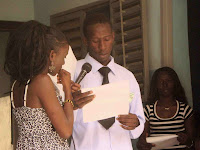 (P.B. delivering speech, with other board members B. and F. looking on)
clip "mboolo mooy doole" (strength in numbers)
In French, "Merci" is often answered with "De rien," meaning "It's nothing."
In Wolof the response to "Jerejef" (thank you) is "Nio ko bokk", which literally means "we (all) share it."
I understood the real meaning of "nio ko bokk" last weekend when I was in Dakar visiting friends. On Sunday I had the pleasure of being invited to a "Journée d'Amitié" that was held by a youth group in my best Senegalese friend's neighborhood in the northern suburbs of the capital. It's a new community group, non-religiously-affiliated, with the goal of getting together young adults in the neighborhood so they can help each other out, talk about common problems, work together to create jobs and support each other. I think it's very cool that they're doing this, and my friend A. is one of their founding members.
Sunday they held this "Friendship Day" that was about advertising the group, getting people to meet people, and just having fun. They served lunch, talked about what the group is doing and what projects they hope to do, people introduced themselves, and then there was music and dancing. I had a blast, and was so proud of all of them for their initiative and self-motivation. Being the so-called "development agent" that is my role here, I couldn't help thinking that there in front of me I was seeing what I had been saying to other volunteers that Senegal needs - Senegalese who take it upon themselves to help each other, who don't just reach out to outside sources to beg for handouts, who look at their peers as resource people and seek solutions to their problems next door, instead of the next continent over.
In that afternoon I felt the glow of success, and a hopefulness that has often escaped me in my work at site. This was not something that I had worked for, nothing here was the result of my participation, and yet I felt pride that I could simply be there to witness this achievement. True, these people are just beginning, this group is just getting started. Who knows where they will go from here, if their success will continue. But the fact that they are trying, not waiting for anyone to help them but stepping up to help themselves, is, to me, huge. I cannot count the number of times I have talked with other volunteers about the questionable sustainability of our work here, the validity of "development work" and the merit or lack thereof of external agents intervening in countries like Senegal. As strangers from foreign lands dropping in to tell local people how to do something better that they've done a certain way for centuries, I often feel that our presence here hinders more than helps. But at best, I believe that we as volunteers can serve to show the Senegalese that there are different ways of thinking about things. Because who is to say what is better? What is better for an American may not be better for a Senegalese. I believe that what is eventually going to help better Senegal needs to come from within Senegal itself.
So I applaud these brave young adults, who aren't willing to join so many of their peers in resignation like all the young Senegalese I meet who complain to me about their own country, who cross their arms and say over and over, "Senegal neexul, fii amul xaalis." (Senegal is terrible, there's no money here.) Having come to this country with the aim of helping people here to help themselves, I have often been discouraged to see the overwhelming number of people who don't even want to try to help themselves. But here is a group who are walking the walk, stepping up to the plate and doing something. I couldn't think of a better way to start to say goodbye to this place than by seeing at least one small part of it that really doesn't need my help. Because their success is mine as well, and yours, wherever you are.
We all share it.
 (The Amicale's president P.B. practicing his speech, with sister looking on)
 (P.B. delivering speech, with other board members B. and F. looking on)
clip "mboolo mooy doole" (strength in numbers)
what is reality
I am not going to apologize for my last entry, as much as it was harsh and written during a long moment of anger. I started this blog to share with people outside of this experience what it is that I am really living in this country. Over the last two years I have lived through many moments that I have chosen not to record here, trying to keep in mind a sense of equilibrium in what I convey. This being said, it seems to me that some readers would still only like to hear about my successes, the bright side of being a Peace Corps volunteer, the days I get to say, “Yes, this is why I came!”
But this experience is not all sunshine, rainbows and happy smiling children. Peace Corps service would not be something so many call “life-changing” if it were not for the low points, the times when nothing seems to go right, when everything you try looks like a failure and your own neighbors are laughing at your face before you even get out of your front door in the morning.
I did not write my last post in a ploy for pity, but simply in an effort to express a reality. My reality. This is, after all, my perception of my own experience.
But if we are talking about impartiality and giving equal weight to both extremes of a sliding scale, I urge you to remember that no two Peace Corps services are alike, even within the same country, even within the same work sector. I have a friend who lives only 45 kilometers away in a 300-person village without electricity. His experience has been vastly different than mine, yet we are both Environmental Education Peace Corps volunteers serving in Senegal. see Chris' blog Most volunteers in Senegal serve in small villages, but another one of my best friends lives in the capital of 3 million, see Jared’s blog and yet another in a city of 120,000. Each one of them has their own experience, their own story to tell, their own perception of what constitutes a success.
Now think about the number of countries in which Peace Corps volunteers are serving around the world, multiplied by the number of volunteers in those countries, and you will come up with the number of different experiences that still all qualify as “the Peace Corps experience”.
Mine is only one small page in the encyclopedia that’s still being written.
Every day I have failures. Some days I have successes too. And I admit that the closer I get to finishing my service the harder it becomes to focus on the successes, as much as I know how important it will be to me to leave here on a positive note.
When I do take a minute to think about where I have succeeded, I can see that most of my successes have been personal ones, not great work achievements. I can’t say for certain that because of my presence here over the last two years I’ve changed anyone’s life in this town. It’s only when I look at myself that I can see real evidence of change.
But this experience is not all sunshine, rainbows and happy smiling children. Peace Corps service would not be something so many call “life-changing” if it were not for the low points, the times when nothing seems to go right, when everything you try looks like a failure and your own neighbors are laughing at your face before you even get out of your front door in the morning.
I did not write my last post in a ploy for pity, but simply in an effort to express a reality. My reality. This is, after all, my perception of my own experience.
But if we are talking about impartiality and giving equal weight to both extremes of a sliding scale, I urge you to remember that no two Peace Corps services are alike, even within the same country, even within the same work sector. I have a friend who lives only 45 kilometers away in a 300-person village without electricity. His experience has been vastly different than mine, yet we are both Environmental Education Peace Corps volunteers serving in Senegal. see Chris' blog Most volunteers in Senegal serve in small villages, but another one of my best friends lives in the capital of 3 million, see Jared’s blog and yet another in a city of 120,000. Each one of them has their own experience, their own story to tell, their own perception of what constitutes a success.
Now think about the number of countries in which Peace Corps volunteers are serving around the world, multiplied by the number of volunteers in those countries, and you will come up with the number of different experiences that still all qualify as “the Peace Corps experience”.
Mine is only one small page in the encyclopedia that’s still being written.
Every day I have failures. Some days I have successes too. And I admit that the closer I get to finishing my service the harder it becomes to focus on the successes, as much as I know how important it will be to me to leave here on a positive note.
When I do take a minute to think about where I have succeeded, I can see that most of my successes have been personal ones, not great work achievements. I can’t say for certain that because of my presence here over the last two years I’ve changed anyone’s life in this town. It’s only when I look at myself that I can see real evidence of change.
Thursday, March 4, 2010
I feel for you, Angelina
I’ve had it with this superstardom business.
Being the biggest fish in this cramped pond. Feeling like Miss America on parade on a good day, or on a bad one, a Ripley’s Believe It or Not attraction.
Having everyone know my name, everyone always wanting to talk to me, wanting a piece of me. Having my every move scrutinized, commented upon, and more often than not, laughed at. It is not exaggerating to say that of the Senegalese I interact with here, in general, men are desirous of me, women are critical of me, children laugh at me and most babies cry if I so much as look at them.
Put this way, you can see how it becomes difficult to feel accepted into a community when at any one time I am simultaneously being rejected by three-quarters of the society, and the other one quarter doesn’t actually take me seriously.
You’d think maybe I would feel better about my integration after almost 2 years here, after being in constant contact with locals and even living with a Senegalese family. After learning the local language (and becoming better than conversational), learning local customs and adjusting to the heat, wind, and frequent cuts in power and water. And yet, as I look ahead to returning to the States in a few short months, I have come to realize that as much as I have done to integrate into this country, there is still only so much respect that can be gained here by a single, young, white female.
I knew relatively early on in this venture that my youth would not be something working in my favor in this culture that reveres age as equal to wisdom, but I underestimated how much my femininity would make my time here not only difficult but fraught with daily battles. In this male-dominated country, in my work I have to constantly be on edge. How to work with men without anyone getting the wrong idea? To do my job it is necessary for me to approach men outside of my host family, to talk to them, telephone them, interact with them; all things that would make a young Senegalese woman seem audacious, bold, risqué. Yet the majority of motivated teachers are men, as well as school directors, city hall workers, national park agents… essentially every important post in town is occupied by a man. Add in the unfavorable media portrayal of Western women as sex-crazed and easy... and every single day I work here I get hit on, stared at, ogled, teased, pestered and generally abused, when all I want to do is my job.
The added factor of being white, “Toubab”, has not added to my credibility with most of the population, especially in my own site, since it is a fairly touristy city that sees a good number of white people but who never spend more than a day in town, meaning that tourists (99% white, of Western European origin) have gotten a bad reputation as people who simply use the town, never give back, and never stick around long enough for the locals to get to know them as real people. Anyone else who comes into town and happens to be white gets subjected to the same treatment as a tourist. So considering the size of town, (around 40,000) it is impossible for everyone coming and going to know that I am not, in fact, a tourist. Every day I cross someone new who thinks I am just a money-spending foreigner come on holiday to “see some local flavor”. Oh, and I forgot to mention the small percentage of white female tourists who come to do more than just “see” the local flavor, if you get what I mean. The locals’ common knowledge of that practice also doesn’t help my reputation with the 90% of my city’s population who doesn’t know me.
So, despite all the months I have spent here, I can count on any given day going out into this town where I live and being treated like a foolish youth, a circus clown, a sex object or a whore.
It’s a bit hard to find stability in that.
And yet people here wonder why I am less than enthusiastic when they suggest I stay another two years.
Being the biggest fish in this cramped pond. Feeling like Miss America on parade on a good day, or on a bad one, a Ripley’s Believe It or Not attraction.
Having everyone know my name, everyone always wanting to talk to me, wanting a piece of me. Having my every move scrutinized, commented upon, and more often than not, laughed at. It is not exaggerating to say that of the Senegalese I interact with here, in general, men are desirous of me, women are critical of me, children laugh at me and most babies cry if I so much as look at them.
Put this way, you can see how it becomes difficult to feel accepted into a community when at any one time I am simultaneously being rejected by three-quarters of the society, and the other one quarter doesn’t actually take me seriously.
You’d think maybe I would feel better about my integration after almost 2 years here, after being in constant contact with locals and even living with a Senegalese family. After learning the local language (and becoming better than conversational), learning local customs and adjusting to the heat, wind, and frequent cuts in power and water. And yet, as I look ahead to returning to the States in a few short months, I have come to realize that as much as I have done to integrate into this country, there is still only so much respect that can be gained here by a single, young, white female.
I knew relatively early on in this venture that my youth would not be something working in my favor in this culture that reveres age as equal to wisdom, but I underestimated how much my femininity would make my time here not only difficult but fraught with daily battles. In this male-dominated country, in my work I have to constantly be on edge. How to work with men without anyone getting the wrong idea? To do my job it is necessary for me to approach men outside of my host family, to talk to them, telephone them, interact with them; all things that would make a young Senegalese woman seem audacious, bold, risqué. Yet the majority of motivated teachers are men, as well as school directors, city hall workers, national park agents… essentially every important post in town is occupied by a man. Add in the unfavorable media portrayal of Western women as sex-crazed and easy... and every single day I work here I get hit on, stared at, ogled, teased, pestered and generally abused, when all I want to do is my job.
The added factor of being white, “Toubab”, has not added to my credibility with most of the population, especially in my own site, since it is a fairly touristy city that sees a good number of white people but who never spend more than a day in town, meaning that tourists (99% white, of Western European origin) have gotten a bad reputation as people who simply use the town, never give back, and never stick around long enough for the locals to get to know them as real people. Anyone else who comes into town and happens to be white gets subjected to the same treatment as a tourist. So considering the size of town, (around 40,000) it is impossible for everyone coming and going to know that I am not, in fact, a tourist. Every day I cross someone new who thinks I am just a money-spending foreigner come on holiday to “see some local flavor”. Oh, and I forgot to mention the small percentage of white female tourists who come to do more than just “see” the local flavor, if you get what I mean. The locals’ common knowledge of that practice also doesn’t help my reputation with the 90% of my city’s population who doesn’t know me.
So, despite all the months I have spent here, I can count on any given day going out into this town where I live and being treated like a foolish youth, a circus clown, a sex object or a whore.
It’s a bit hard to find stability in that.
And yet people here wonder why I am less than enthusiastic when they suggest I stay another two years.
Tuesday, February 23, 2010
entering the home stretch
“Ngoné Ndiaye! Gej naa la gis!
Mais yow foo nekkoon? Xanaa nekkofiiwoon? Defee naa ne danga dellu dekk bi té taggatoo ma!”
[Ngoné Ndiaye! It’s been such a long time since I’ve seen you! Where have you been? Were you not here? I thought maybe you went back to your country and didn’t say goodbye!]
I know, it’s been a long time.
That’s what you get when you leave site for over two weeks. It’s the longest I’d been away since last summer, when I went to the States for 3 weeks. Usually I only leave town for a few days at a time, go to the capital, visit friends. But I had good reasons to be away so long this time.
I’d planned to be gone for at least ten days, with my original training group’s 3-day COS conference in Dakar, then 2 days of All-Volunteer conference, 3 days of WAIST, with a day to get in and a day to leisurely come back to site. And then a week and a half before all that started, I ended up falling victim to what was diagnosed as carbon monoxide poisoning, and spent an extra 5 days in Dakar recovering at the PC office Med hut, before all the rest of my planned activities… (I’m pretty much better now)
And once WAIST was over I took two more days to get some things done at our PC office, and finally came back on Thursday to Joal (my site), my dusty room, and my happy host family.
[Sorry for the acronyms: COS = Close of Service
WAIST = West Africa Invitational Softball Tournament
PC = you should know by now = Peace Corps]
[for more details on our COS conference and WAIST,
check out my friend Bethany's blog ]
Two weeks is a long time to be away, and I had let myself get pretty disconnected.
Dakar, the capital, is still Senegal, but parts of it are very Western. Spending almost a week in the Peace Corps office, three days being put up in a posh hotel for COS conference (thank you, US tax dollars) and then another five days at an American-Senegalese couple’s place in US Embassy housing (thanks to the great homestay program instituted by our PC country director)… well, it honestly felt more like America than Senegal.
I suppose I needed that.
Though I have taken mini-breaks every now and then since last summer’s big “vacation”, I was feeling run down, tired, and pretty much just ready to get the heck outta here. I spent most of January feeling like I was just treading water, being physically present but mentally distant, defining in essence the ubiquitous Wolof phrase, “Maangiy fii rekk” - I am here only. I found myself at a loss for work, after the busy-ness of the past few months, yet not so eager to start anything new. Then just after New Year’s I was presented with a proposition by my supervisor to consider extending my service for another year, to be the Environmental Ed program assistant, based in Dakar.
And as run down and fed up as I felt, I almost decided to say yes.
Until I made a spur of the moment visit to a PCV friend in Thiès and realized that staying another year here would be exactly the opposite of what I want.
It’s not that this is such a terrible place - don’t get me wrong. But two years is enough.
My brain was telling me logically that I should do it, that a third year here would indeed be a good job opportunity, a potential for more growth, and so on and so on. I would have gotten a month-long paid leave to go home before starting the third year, and once back in Senegal, a nice set-up with my own apartment in Dakar, more administrative duties, more freedom and a continued PC-paid living allowance and health benefits.
But after all but making the decision to stay, I realized that it was not what I wanted.
And as one of my goals for my Peace Corps service was to stop doing things just because I think I “should”, and only do things that I really “want” to do, once I had let myself be honest and admit that what I really wanted was to go home, I felt a huge burden lifted, and knew I had made the right decision.
January was tough in many ways, but mostly in battling my own thoughts. I got up every day and went to City Hall, met with my counterpart and work partners, listened much, talked a little. But I can’t say I accomplished anything great. I managed to organize one meeting of the CCEE - Comité Communal d’Education Environnementale. But since that meeting we haven’t had another, I’ve been away, more than a month has gone by and we haven’t done anything we talked about doing during that January meeting. And now it’s almost March, and I am looking at the home stretch: finishing my service, figuring out how to give some closure to my time here, passing on projects and allowing myself to accept that it’s OK that there are things I didn’t do.
I sat down in my little corner office at City Hall yesterday (yes, technically I have an office, though it’s not where I spend most of my time) and looked at my calendar. Before we left COS conference we were supposed to choose a COS date, let the administration know when we would be closing up shop. The official COS date for my training group is May 8 - that is the date around which most of us will be leaving country. We swore in officially as volunteers on May 9, 2008, so two years after that we will have completed our allotted time. We are allowed to leave up to 30 days before or 30 days after that date, with a few exceptions, so considering when I want to be here at site for the week or so site visit in April of my incoming replacement, plus time to finish up, say goodbyes, etc, I chose May 20 as my COS date. That doesn’t mean I will be necessarily flying back to the States that day, but unless anything changes in the meantime, it will be my last official day as a PCV.
May 20. I looked at my calendar, then at my packet of COS’ing information, calculating days and timing of closing-out medical appointments, reports that will need to be written, books to be returned, goodbyes to be said. I’ll probably leave Joal a good ten days before my COS date, to get everything done in Dakar that will need to be done before I can leave. I looked back at my calendar, counting the weeks. Counting the days. Eleven weeks at site. Take out Sundays, a Saturday here and there… that leaves about 60 working days. Sixty days.
After so much time, just two more months.
Mais yow foo nekkoon? Xanaa nekkofiiwoon? Defee naa ne danga dellu dekk bi té taggatoo ma!”
[Ngoné Ndiaye! It’s been such a long time since I’ve seen you! Where have you been? Were you not here? I thought maybe you went back to your country and didn’t say goodbye!]
I know, it’s been a long time.
That’s what you get when you leave site for over two weeks. It’s the longest I’d been away since last summer, when I went to the States for 3 weeks. Usually I only leave town for a few days at a time, go to the capital, visit friends. But I had good reasons to be away so long this time.
I’d planned to be gone for at least ten days, with my original training group’s 3-day COS conference in Dakar, then 2 days of All-Volunteer conference, 3 days of WAIST, with a day to get in and a day to leisurely come back to site. And then a week and a half before all that started, I ended up falling victim to what was diagnosed as carbon monoxide poisoning, and spent an extra 5 days in Dakar recovering at the PC office Med hut, before all the rest of my planned activities… (I’m pretty much better now)
And once WAIST was over I took two more days to get some things done at our PC office, and finally came back on Thursday to Joal (my site), my dusty room, and my happy host family.
[Sorry for the acronyms: COS = Close of Service
WAIST = West Africa Invitational Softball Tournament
PC = you should know by now = Peace Corps]
[for more details on our COS conference and WAIST,
check out my friend Bethany's blog ]
Two weeks is a long time to be away, and I had let myself get pretty disconnected.
Dakar, the capital, is still Senegal, but parts of it are very Western. Spending almost a week in the Peace Corps office, three days being put up in a posh hotel for COS conference (thank you, US tax dollars) and then another five days at an American-Senegalese couple’s place in US Embassy housing (thanks to the great homestay program instituted by our PC country director)… well, it honestly felt more like America than Senegal.
I suppose I needed that.
Though I have taken mini-breaks every now and then since last summer’s big “vacation”, I was feeling run down, tired, and pretty much just ready to get the heck outta here. I spent most of January feeling like I was just treading water, being physically present but mentally distant, defining in essence the ubiquitous Wolof phrase, “Maangiy fii rekk” - I am here only. I found myself at a loss for work, after the busy-ness of the past few months, yet not so eager to start anything new. Then just after New Year’s I was presented with a proposition by my supervisor to consider extending my service for another year, to be the Environmental Ed program assistant, based in Dakar.
And as run down and fed up as I felt, I almost decided to say yes.
Until I made a spur of the moment visit to a PCV friend in Thiès and realized that staying another year here would be exactly the opposite of what I want.
It’s not that this is such a terrible place - don’t get me wrong. But two years is enough.
My brain was telling me logically that I should do it, that a third year here would indeed be a good job opportunity, a potential for more growth, and so on and so on. I would have gotten a month-long paid leave to go home before starting the third year, and once back in Senegal, a nice set-up with my own apartment in Dakar, more administrative duties, more freedom and a continued PC-paid living allowance and health benefits.
But after all but making the decision to stay, I realized that it was not what I wanted.
And as one of my goals for my Peace Corps service was to stop doing things just because I think I “should”, and only do things that I really “want” to do, once I had let myself be honest and admit that what I really wanted was to go home, I felt a huge burden lifted, and knew I had made the right decision.
January was tough in many ways, but mostly in battling my own thoughts. I got up every day and went to City Hall, met with my counterpart and work partners, listened much, talked a little. But I can’t say I accomplished anything great. I managed to organize one meeting of the CCEE - Comité Communal d’Education Environnementale. But since that meeting we haven’t had another, I’ve been away, more than a month has gone by and we haven’t done anything we talked about doing during that January meeting. And now it’s almost March, and I am looking at the home stretch: finishing my service, figuring out how to give some closure to my time here, passing on projects and allowing myself to accept that it’s OK that there are things I didn’t do.
I sat down in my little corner office at City Hall yesterday (yes, technically I have an office, though it’s not where I spend most of my time) and looked at my calendar. Before we left COS conference we were supposed to choose a COS date, let the administration know when we would be closing up shop. The official COS date for my training group is May 8 - that is the date around which most of us will be leaving country. We swore in officially as volunteers on May 9, 2008, so two years after that we will have completed our allotted time. We are allowed to leave up to 30 days before or 30 days after that date, with a few exceptions, so considering when I want to be here at site for the week or so site visit in April of my incoming replacement, plus time to finish up, say goodbyes, etc, I chose May 20 as my COS date. That doesn’t mean I will be necessarily flying back to the States that day, but unless anything changes in the meantime, it will be my last official day as a PCV.
May 20. I looked at my calendar, then at my packet of COS’ing information, calculating days and timing of closing-out medical appointments, reports that will need to be written, books to be returned, goodbyes to be said. I’ll probably leave Joal a good ten days before my COS date, to get everything done in Dakar that will need to be done before I can leave. I looked back at my calendar, counting the weeks. Counting the days. Eleven weeks at site. Take out Sundays, a Saturday here and there… that leaves about 60 working days. Sixty days.
After so much time, just two more months.
performance review
In an effort to show that I have actually been doing something here besides whining about the heat and fighting off constant marriage proposals, here is a copy of my supervisor's comments from my latest quarterly report, which I wrote for the months of September, October and November (and submitted in January, just a little late.) It's not exactly current news, but I thought I'd share anyway.
Date: February 3, 2010
TO: Alexis Zackey, PCV Joal
From: Mamadou Diaw, APCD/NRM
Subject: Quarterly report
Dear Alexis,
Thanks for submitting your quarterly report that is very detailed and well written as usual. I Hope that you are continuing to do well both socially and professionally.
Here are my comments on your report.
Activities:
1. Helped write and carry out a short survey to determine the reason for the decline of sales of the compost sold at the solid waste management facility
Problems/ Challenges: Finding honest, unbiased information in a small community was very difficult. She found that local farmers did not understand that buying the compost locally would help their community. Even though the survey was completed, the group in charge of the waste management facility has not yet met to discuss the results of the survey.
2. The Joal EE committee planned a workshop for all 12 primary and middle schools , this was funded by a local Italian NGO, LVIA. Students watched the solid waste management documentary, viewed a sketch by the local theatre troupe and then broke up into “work groups” which presented at the end of the day.
Problems/ Challenges: The regular large meeting stresses, and problems trying to get the teachers to take ownership of the committee that they see as being run by the volunteer. Also, those that were voted as the group coordinators are too busy with other work to devote extra time to the committee.
Secondary Projects:
-helped to host International Volunteer day in Joal. This was a success as it generated revenue for the community and was able to increase awareness of volunteer work and its importance throughout the local Joal community as well as those attending the conference. [blog post about IVD here]
- helped facilitate a French children’s documentary on environmental awareness (can PC get a copy of this?) [read more about Projet Esperanto here]
Future plans:
-drawing a work plan for PCV replacement
-continued work with the CCEE-Comite Communal d’Education Environmentale) to create other activities to be carried out before the end of the school year
Comments: Congratulations on another successful quarter at site. Your time in the Peace Corps has been exemplary in both local, community support and programmatic level. As for your primary activities, I agree that the survey is an excellent idea, but difficult to implement. When you do meet with the waste management committee to talk about the results of the survey, you might want to think of creating a sort of awareness/advertising campaign for the composted fertilizer. This would allow local farmers to take notice of the impact the composted fertilizer will make on their crops and the fact that they are supporting their local community when they buy the product.
The workshop that you facilitated with your CCEE group sounds like an intense undertaking. I was impressed to hear how flexible you were in implementing the program and how it all seemed to work out well. I did notice you added a per diem in the budget for the officials and teachers. This may have a negative effect for future conferences and programs of this nature if they think that they will always receive per diem for their attendance. This should also be addressed in your next CCEE meeting. I understand your concern for sustainability with the CCEE as this is always a difficult concept. Your replacement and your site mate will be able to keep the group accountable to some degree, but I do think it is a good idea to elect an official who’s primary job will be to attend and facilitate every meeting
Your secondary projects are also a testament to your excellent work.
Thank you for your involvement in Volunteer Day, your help was greatly appreciated by all those involved in making a successful and informative celebration. Concerning the French documentary that you helped to facilitate is there a chance we would be able to have a copy of it the finished product for our library in Dakar. This sounds like a great resource for future AV teaching materials in EE. Finally, I would be happy to work with you to create a work plan for your PCV replacement and to gain thoughts for the future of our program in Joal-Fadiouth.
Date: February 3, 2010
TO: Alexis Zackey, PCV Joal
From: Mamadou Diaw, APCD/NRM
Subject: Quarterly report
Dear Alexis,
Thanks for submitting your quarterly report that is very detailed and well written as usual. I Hope that you are continuing to do well both socially and professionally.
Here are my comments on your report.
Activities:
1. Helped write and carry out a short survey to determine the reason for the decline of sales of the compost sold at the solid waste management facility
Problems/ Challenges: Finding honest, unbiased information in a small community was very difficult. She found that local farmers did not understand that buying the compost locally would help their community. Even though the survey was completed, the group in charge of the waste management facility has not yet met to discuss the results of the survey.
2. The Joal EE committee planned a workshop for all 12 primary and middle schools , this was funded by a local Italian NGO, LVIA. Students watched the solid waste management documentary, viewed a sketch by the local theatre troupe and then broke up into “work groups” which presented at the end of the day.
Problems/ Challenges: The regular large meeting stresses, and problems trying to get the teachers to take ownership of the committee that they see as being run by the volunteer. Also, those that were voted as the group coordinators are too busy with other work to devote extra time to the committee.
Secondary Projects:
-helped to host International Volunteer day in Joal. This was a success as it generated revenue for the community and was able to increase awareness of volunteer work and its importance throughout the local Joal community as well as those attending the conference. [blog post about IVD here]
- helped facilitate a French children’s documentary on environmental awareness (can PC get a copy of this?) [read more about Projet Esperanto here]
Future plans:
-drawing a work plan for PCV replacement
-continued work with the CCEE-Comite Communal d’Education Environmentale) to create other activities to be carried out before the end of the school year
Comments: Congratulations on another successful quarter at site. Your time in the Peace Corps has been exemplary in both local, community support and programmatic level. As for your primary activities, I agree that the survey is an excellent idea, but difficult to implement. When you do meet with the waste management committee to talk about the results of the survey, you might want to think of creating a sort of awareness/advertising campaign for the composted fertilizer. This would allow local farmers to take notice of the impact the composted fertilizer will make on their crops and the fact that they are supporting their local community when they buy the product.
The workshop that you facilitated with your CCEE group sounds like an intense undertaking. I was impressed to hear how flexible you were in implementing the program and how it all seemed to work out well. I did notice you added a per diem in the budget for the officials and teachers. This may have a negative effect for future conferences and programs of this nature if they think that they will always receive per diem for their attendance. This should also be addressed in your next CCEE meeting. I understand your concern for sustainability with the CCEE as this is always a difficult concept. Your replacement and your site mate will be able to keep the group accountable to some degree, but I do think it is a good idea to elect an official who’s primary job will be to attend and facilitate every meeting
Your secondary projects are also a testament to your excellent work.
Thank you for your involvement in Volunteer Day, your help was greatly appreciated by all those involved in making a successful and informative celebration. Concerning the French documentary that you helped to facilitate is there a chance we would be able to have a copy of it the finished product for our library in Dakar. This sounds like a great resource for future AV teaching materials in EE. Finally, I would be happy to work with you to create a work plan for your PCV replacement and to gain thoughts for the future of our program in Joal-Fadiouth.
Sunday, January 10, 2010
half a million minutes
It is 2010. Which means that I spent all of last year - minus my 3 weeks vacation to the U.S. - in Africa. Senegal, specifically.
That’s 49 weeks. 343 days. 8232 hours. 493,920 minutes (or so). Not like I’m counting…
So in honor of my last half a million minutes (and lacking anything better to write about) here are a few highlights from my 2009.
2009 In (Approximate) Numbers, In No Particular Chronological or Otherwise Order.
Books read: 9
Books read by Amy Tan: 2
Books started but not finished: 3
Cravings had for tuna fish on white bread: 1
Dreams about iced cream-filled donuts: 1
Packets of orange Foster Clark’s instant drink mix consumed: 83
Bananas eaten: 302
Times called “Toubab”: 3,573
Requests for money or gifts: 1,897
Babies born to neighbors or friends: 11
Babies named after me: 1
Baptisms actually attended: 2
Times I had to type the words “education environnementale” : 157
Letters in “environnementale” : 16
Pounds lost (since January): 15
Pairs of jeans I own that still fit me well: 0
Pairs of cheap flip-flops bought from corner store: 4
Days fasted during Ramadan: 8
Earth Day celebrations organized: 1
Local radio interviews given in Wolof: 4
Neighborhood clean-ups participated in: 3
Community-wide environmental education committees created: 1
Peace Corps Volunteer Advisory Council meetings attended: 2
Presidential Inauguration speeches missed because of traffic jams: 1
U.S. Ambassadors to Senegal met: 1
Amateur championship soccer matches attended: 2
Bucket baths taken: 612
Anti-malarial Doxycycline pills swallowed: 365
Host family members who took pilgrimages to Mecca: 2
Francs CFA spent on phone credit: 250,000
Percent of year’s salary that equals: 10.2
Packages of underwear received in the mail: 1
All-night dance parties attended: 3
New Indian teledramas airing on national TV: 1
From 1-10 how much better this show is than current Brazilian teledrama: 10
To-Do lists written: 289
27th birthdays celebrated: 1
Apple pies baked: 2
Cavities filled: 3
Journals filled: 2
Christmas Eves spent cooking dinner in a pit fire on a beach: 1
That’s 49 weeks. 343 days. 8232 hours. 493,920 minutes (or so). Not like I’m counting…
So in honor of my last half a million minutes (and lacking anything better to write about) here are a few highlights from my 2009.
2009 In (Approximate) Numbers, In No Particular Chronological or Otherwise Order.
Books read: 9
Books read by Amy Tan: 2
Books started but not finished: 3
Cravings had for tuna fish on white bread: 1
Dreams about iced cream-filled donuts: 1
Packets of orange Foster Clark’s instant drink mix consumed: 83
Bananas eaten: 302
Times called “Toubab”: 3,573
Requests for money or gifts: 1,897
Babies born to neighbors or friends: 11
Babies named after me: 1
Baptisms actually attended: 2
Times I had to type the words “education environnementale” : 157
Letters in “environnementale” : 16
Pounds lost (since January): 15
Pairs of jeans I own that still fit me well: 0
Pairs of cheap flip-flops bought from corner store: 4
Days fasted during Ramadan: 8
Earth Day celebrations organized: 1
Local radio interviews given in Wolof: 4
Neighborhood clean-ups participated in: 3
Community-wide environmental education committees created: 1
Peace Corps Volunteer Advisory Council meetings attended: 2
Presidential Inauguration speeches missed because of traffic jams: 1
U.S. Ambassadors to Senegal met: 1
Amateur championship soccer matches attended: 2
Bucket baths taken: 612
Anti-malarial Doxycycline pills swallowed: 365
Host family members who took pilgrimages to Mecca: 2
Francs CFA spent on phone credit: 250,000
Percent of year’s salary that equals: 10.2
Packages of underwear received in the mail: 1
All-night dance parties attended: 3
New Indian teledramas airing on national TV: 1
From 1-10 how much better this show is than current Brazilian teledrama: 10
To-Do lists written: 289
27th birthdays celebrated: 1
Apple pies baked: 2
Cavities filled: 3
Journals filled: 2
Christmas Eves spent cooking dinner in a pit fire on a beach: 1
Tuesday, December 15, 2009
“…in the jingle jangle morning I'll come followin you”
All the familiar signs of the current season are absent here. No festive music playing in stores, no frenzied shoppers racing about, no constant stream of advertising…
Only my wall calendar quietly tells me that a mere ten days are left before the biggest holiday in the Western world. A hint of cold wakes me up in the mornings these days, and I linger in bed to enjoy it, knowing that even as I shiver to take my bucket bath at 9 a.m., the midday sun will still beat down in its dry December warmth. I consider my situation, my distance from where I call home, and think about how much I miss bitter cold, frost on the grass, icicles hanging from heavy tree branches, a cup of hot chocolate in my cold hands. I miss feeling the excitement of an upcoming vacation, as even if I leave my site over the holiday I will still be in Senegal, and still a Peace Corps Volunteer, doing my job 24 hours a day, 7 days a week. As I’ve pointed out before, this job is one that has no boundaries, no “quitting time”. Whenever I interact with a Senegalese person I’m doing one part of my job, so that’s pretty much most of my time…
Maybe you’ve noticed my tone is not an eager, enthusiastic one today. I admit it: I am tired. I have been working almost constantly over the last month, with a few short breaks for Thanksgiving and Tabaski, and juggling increasingly frequent thoughts about how to concentrate on my current work while considering wrapping up my time here. People are starting to ask what I will do “after”, and I am hoping in the next few weeks to have some down time to start thinking about that. I got nastily sick two days before our big International Day of the Volunteer event, though fortunately recovering quickly, but I think whatever it was weakened my system because two days after the weekend of the IDV to-do I came down with a cold that came on strong and has hung on for the past week.
Being sick has forced me to take things easier over the last few days, and fortunately the pace of work has also obligingly decelerated, with only one major project now demanding my attention for the next few weeks. Our three days of International Day of the Volunteer “celebrations” (December 4-6) went over remarkably well I’d say, considering my extensive pre-event worries, and the city pulled off hosting several hundred people with only some slight delays in food preparation and last-minute ceremony lineup rearrangements. After much fretting, the part of the ceremony planned for PCVs to “present their experience in community environmental management” ended up getting skipped, so the SED APCD (Small Enterprise Development Assistant Program Country Director) didn’t get to speak about Peace Corps’ role in starting the city’s now-famous pilot waste management project, nor did I have to take a turn at the podium in front of over 300 people to say my rehearsed Wolof proverb (as the APCD had asked me to do, as a concluding remark). Later on that day however the local radio rep cornered me to get my word on the event, so after not-so-eloquently expressing my feelings (in Wolof, of course) about the importance of recognizing volunteer work, I finished with the proverb I’d memorized for the occasion: “Benn lam ci loxo, keleng du am” - meaning “One single bracelet on a hand will not make a sound.”
It’s a truth universally acknowledged - it takes many to really make something happen. One person can set off a course of action, but without the domino effect of others reacting, that single person’s effort will have little meaning. As Peace Corps Volunteers, we are sent out to our villages and towns alone, single bracelets. But as time passes and we integrate into our communities, gain respect and press on in our task to reinforce local capacities, we gather more and more bracelets around us. My time here is waning and I may wonder how much I have actually accomplished, but I am not dreading leaving this work behind, because although I will eventually go back to the States in a few short months, I have hope that the loss of my single bracelet will not mean the silencing of the jangle I have endeavored to set in motion.


Only my wall calendar quietly tells me that a mere ten days are left before the biggest holiday in the Western world. A hint of cold wakes me up in the mornings these days, and I linger in bed to enjoy it, knowing that even as I shiver to take my bucket bath at 9 a.m., the midday sun will still beat down in its dry December warmth. I consider my situation, my distance from where I call home, and think about how much I miss bitter cold, frost on the grass, icicles hanging from heavy tree branches, a cup of hot chocolate in my cold hands. I miss feeling the excitement of an upcoming vacation, as even if I leave my site over the holiday I will still be in Senegal, and still a Peace Corps Volunteer, doing my job 24 hours a day, 7 days a week. As I’ve pointed out before, this job is one that has no boundaries, no “quitting time”. Whenever I interact with a Senegalese person I’m doing one part of my job, so that’s pretty much most of my time…
Maybe you’ve noticed my tone is not an eager, enthusiastic one today. I admit it: I am tired. I have been working almost constantly over the last month, with a few short breaks for Thanksgiving and Tabaski, and juggling increasingly frequent thoughts about how to concentrate on my current work while considering wrapping up my time here. People are starting to ask what I will do “after”, and I am hoping in the next few weeks to have some down time to start thinking about that. I got nastily sick two days before our big International Day of the Volunteer event, though fortunately recovering quickly, but I think whatever it was weakened my system because two days after the weekend of the IDV to-do I came down with a cold that came on strong and has hung on for the past week.
Being sick has forced me to take things easier over the last few days, and fortunately the pace of work has also obligingly decelerated, with only one major project now demanding my attention for the next few weeks. Our three days of International Day of the Volunteer “celebrations” (December 4-6) went over remarkably well I’d say, considering my extensive pre-event worries, and the city pulled off hosting several hundred people with only some slight delays in food preparation and last-minute ceremony lineup rearrangements. After much fretting, the part of the ceremony planned for PCVs to “present their experience in community environmental management” ended up getting skipped, so the SED APCD (Small Enterprise Development Assistant Program Country Director) didn’t get to speak about Peace Corps’ role in starting the city’s now-famous pilot waste management project, nor did I have to take a turn at the podium in front of over 300 people to say my rehearsed Wolof proverb (as the APCD had asked me to do, as a concluding remark). Later on that day however the local radio rep cornered me to get my word on the event, so after not-so-eloquently expressing my feelings (in Wolof, of course) about the importance of recognizing volunteer work, I finished with the proverb I’d memorized for the occasion: “Benn lam ci loxo, keleng du am” - meaning “One single bracelet on a hand will not make a sound.”
It’s a truth universally acknowledged - it takes many to really make something happen. One person can set off a course of action, but without the domino effect of others reacting, that single person’s effort will have little meaning. As Peace Corps Volunteers, we are sent out to our villages and towns alone, single bracelets. But as time passes and we integrate into our communities, gain respect and press on in our task to reinforce local capacities, we gather more and more bracelets around us. My time here is waning and I may wonder how much I have actually accomplished, but I am not dreading leaving this work behind, because although I will eventually go back to the States in a few short months, I have hope that the loss of my single bracelet will not mean the silencing of the jangle I have endeavored to set in motion.


holidays coast-to-coast
Baal ma, baal naa la. Yalla nu Yalla boole baal.
(Forgive me, I forgive you. May God forgive us all.)
These are the traditional words spoken on Tabaski, the Senegalese name for the Muslim celebration of Eid-Al-Adha, which commemorates the story of God asking Abraham to sacrifice his only son Ishmael to show his commitment to his faith, and at the last second sparing the boy by replacing him with a ram. It is considered the largest holiday in this mostly Muslim culture, and this year the day fell two days after one of the biggest holidays in American culture, Thanksgiving. Because of the proximity of the two days and my prior plans to participate in the U.S. Ambassador’s Thanksgiving dinner in Dakar, my host mother forgave me for staying in the capital to celebrate Tabaski with good friends instead of with my family at site, agreeing that traffic would probably be terrible if I tried to travel back to site right before Tabaski.
It was a strange inversion of emotion, another year of celebrating an American holiday in the midst of a foreign culture, and then participating as an American in a foreign holiday. I am thankful that I had the opportunity to spend Thanksgiving with other American friends, bake a few pies in a borrowed apartment, and sit around a table with others who share my tradition.
I ended up missing my family and friends more on Tabaski, however, than I did on Thanksgiving, a fact that may be hard to comprehend for some of you who will say, “but we don’t celebrate Tabaski.” It’s true that most of us in America don’t celebrate the equivalent of Tabaski, but because it is the biggest holiday here, (and here is where I am now, even though here is not where I’m from) even though I was with friends it felt like I should also have been with my family that day. The feelings of distance and separation from my loves ones that struck me on Thanksgiving were multiplied on Tabaski as I watched my African friends celebrate their blessings, forgive each other for their wrongs, and embrace the importance of being with family.
I’ve posted to my photo site pictures of Thanksgiving preparations and elegant Tabaski outfits, American friends and Senegalese.
http://www.flickr.com/photos/offtoseetheworld/
I’ll leave you today with this quote from a book I picked up over the holiday in our Peace Corps regional house library. After I read this I looked back to the first pages to check the publication date and was surprised to find “1958,” because I find these words just as relevant today as when they were first written half a century ago.
“The community today can be no single tradition; it is the planet. Daily the world grows smaller, leaving understanding the only bridge on which peace can find its home. But the annihilation of distance has caught us unprepared. Who today stands ready to accept the solemn equality of nations? Who does not have to fight an unconscious tendency to equate foreign with inferior? We live in a great century, but if it is to rise to its full opportunity, the scientific achievements of its first half must be matched by comparable achievements in human relations in its second. Those who listen in the present world work for peace, a peace built not upon ecclesiastical or political empire, but upon understanding and the mutual involvement in the lives of others that this brings. For understanding, at least in realms as inherently noble as the great faiths of mankind, brings respect, and respect prepares the way for a higher power, love - the only power that can quench the flames of fear, suspicion, and prejudice, and provide the means by which the peoples of this great earth can become one to one another.”
- Huston Smith, “The Religions of Man”
(Forgive me, I forgive you. May God forgive us all.)
These are the traditional words spoken on Tabaski, the Senegalese name for the Muslim celebration of Eid-Al-Adha, which commemorates the story of God asking Abraham to sacrifice his only son Ishmael to show his commitment to his faith, and at the last second sparing the boy by replacing him with a ram. It is considered the largest holiday in this mostly Muslim culture, and this year the day fell two days after one of the biggest holidays in American culture, Thanksgiving. Because of the proximity of the two days and my prior plans to participate in the U.S. Ambassador’s Thanksgiving dinner in Dakar, my host mother forgave me for staying in the capital to celebrate Tabaski with good friends instead of with my family at site, agreeing that traffic would probably be terrible if I tried to travel back to site right before Tabaski.
It was a strange inversion of emotion, another year of celebrating an American holiday in the midst of a foreign culture, and then participating as an American in a foreign holiday. I am thankful that I had the opportunity to spend Thanksgiving with other American friends, bake a few pies in a borrowed apartment, and sit around a table with others who share my tradition.
I ended up missing my family and friends more on Tabaski, however, than I did on Thanksgiving, a fact that may be hard to comprehend for some of you who will say, “but we don’t celebrate Tabaski.” It’s true that most of us in America don’t celebrate the equivalent of Tabaski, but because it is the biggest holiday here, (and here is where I am now, even though here is not where I’m from) even though I was with friends it felt like I should also have been with my family that day. The feelings of distance and separation from my loves ones that struck me on Thanksgiving were multiplied on Tabaski as I watched my African friends celebrate their blessings, forgive each other for their wrongs, and embrace the importance of being with family.
I’ve posted to my photo site pictures of Thanksgiving preparations and elegant Tabaski outfits, American friends and Senegalese.
http://www.flickr.com/photos/offtoseetheworld/
I’ll leave you today with this quote from a book I picked up over the holiday in our Peace Corps regional house library. After I read this I looked back to the first pages to check the publication date and was surprised to find “1958,” because I find these words just as relevant today as when they were first written half a century ago.
“The community today can be no single tradition; it is the planet. Daily the world grows smaller, leaving understanding the only bridge on which peace can find its home. But the annihilation of distance has caught us unprepared. Who today stands ready to accept the solemn equality of nations? Who does not have to fight an unconscious tendency to equate foreign with inferior? We live in a great century, but if it is to rise to its full opportunity, the scientific achievements of its first half must be matched by comparable achievements in human relations in its second. Those who listen in the present world work for peace, a peace built not upon ecclesiastical or political empire, but upon understanding and the mutual involvement in the lives of others that this brings. For understanding, at least in realms as inherently noble as the great faiths of mankind, brings respect, and respect prepares the way for a higher power, love - the only power that can quench the flames of fear, suspicion, and prejudice, and provide the means by which the peoples of this great earth can become one to one another.”
- Huston Smith, “The Religions of Man”
Thursday, November 19, 2009
they say every day is a learning experience
 After the school-focused trash awareness day I helped to organize last week, these students went home with a (hopefully) better understanding of waste management.
As for me, I went home with a better understanding of event management.
Here are a few things I won’t forget the next time…
1. Start by showing up an hour early for this big event you’ve helped plan, even if you know most of your invitees will be an hour late. You might find that no one has informed the caretaker that there will be 150 people showing up for an event in half an hour.
2. Be on good terms with said caretaker as you might need him to help you set up 100 chairs in the 15 minutes before 100 school kids show up to sit in them.
3. Make sure you have plenty of phone credit minutes on your cell so you can call everyone at the last minute to find out where they are and why they’re not where they’re supposed to be.

4. Remember if you’re screening a film to test run the projector during the day before. It’s easy to forget that at night you will see the movie better because it’s already dark out.
5. Have a backup plan in mind in case your 150-person group gets kicked out of their previously arranged room because the assistant mayor had scheduled a more important (i.e. international donor-led) meeting there already for the same day and the same time but had forgotten to tell you when you asked if you could have that room the week before.
6. Double-check your budget to include contingencies. You never know when your backup plan location’s power box might burst into flames and end up with your group getting blamed for it.
7. Always carry tape and scissors. Extension cords are often flimsy and unreliable.
8. Carry a copy of the event’s agreed-upon budget with you the day of, in case of last minute questions.


9. Wear comfortable clothes so you can move easily as you will likely be constantly sent on errands to keep things running smoothly.
10. Plan to serve your group’s meal in a secluded spot, as opposed to a site where another group is already having a seminar, if you don’t want to have other uninvited people partaking of your carefully budgeted food and beverages.
11. Carry extra cash with you in case you need to go out and buy more beverages for members of your group who were shorted (see number 10).
12. Repeat. Always carry tape and scissors.
13. If during the course of your event you’re giving out t-shirts, pens, notebooks or any other “goodies”, be prepared to fend off constant demands from onlookers for such items.
14. Keep track of all of the event’s attendees, but remember that it is likely many teachers only brought their students because they were promised money for transport and per diem.
15. Remind yourself that at least they came.
16. Be glad you did not have to write up a grant proposal request for this event, and that someone else will be in charge of writing the final report to the donor.
17. Remember to focus on what went right, not just on what went wrong!


stretched a little thin
There is kind of a ridiculous amount of stuff going on in my life right now, so again please excuse my long absence from this page. You may be wondering what I do with all this time I supposedly don’t have ;) Well. Here’s part of a letter I wrote last week to help explain. (Sorry Dad, hope you don’t mind…)
[dated November 9, 2009]
“Work has been keeping me super busy these last weeks, since October started pretty much, and school picked up. I’m working on three major projects right now. The first and ongoing one is this new committee we’ve started, a city-wide environmental education committee that regroups reps from all the 12 elementary and middle schools in [the city] with the objective to work together to more effectively teach environmental education. With this committee and the committee that manages the city’s pilot waste management project we are organizing a student “trash awareness day” this Wednesday, where we’ve invited 10 kids from each of the 12 schools, along with 2 teachers per school, and we’re going to show them a few short videos on trash and plastics recycling, then lead discussion sessions, give them lunch, and break into workshops to discuss solutions. I hope it goes well, we’ve been planning this for several weeks now and yet some major details (like who would be cooking lunch) were still up in the air as of today, 2 days before the planned event… I have to remember that this is Senegal and that’s the way so many things work here, but it’s still unsettling to me, the structured American…
Besides the committee, I’ve been roped into helping to plan this International Day of the Volunteer celebration, which will (Inch’Allah) take place in [my city] this December 5. It’s a big deal for the community, as this is the first year they’re doing this annual day’s celebration outside of the capital city, and all kinds of bigwigs are invited, ambassadors and other such VIPs. So that’s in the works as a 3-day affair intended to welcome as many as 500 people, and not too many weeks left before that.
My third project on tap is not easily summed up in one succinct sentence, but consists essentially of being a liaison and a facilitator, which is what I, as a Peace Corps volunteer, pride myself in being good at (if I do say so myself). But let me not speak too soon, as the major work of this project is yet to come. The city is expecting the arrival of a French film crew on November 21-ish: a group calling themselves Projet Esperanto, whose vision is to produce a short film, featuring children, focused on the importance of protecting the world’s precious water resources. Their plan is to film one part of their documentary/storytelling movie in 5 different francophone countries, spending a few weeks respectively in France, Morocco, Senegal, Guyana, and Guadeloupe. Through contacts with WWF (World Wildlife Fund) France and WWF Senegal, my site got chosen as their destination in Senegal, and with my position as Environmental Education volunteer here, the adjunct mayor asked me to work on this project with the project team once they come. I’m a little worried that I’m already pretty weighed down with work but I’m very excited to see how I can be of help, as a link between the filming team and the school they want to work with. To read more about their project, you can check out their website - http://www.projet-esperanto.fr/projet.htm - though it is in French ☺
As you can see I’m keeping myself busy. Or maybe it would be more correct to say that I’m being kept busy… At any rate, other than work, and the weather becoming much more agreeable, I am trying to find time to look ahead and start to consider my options for post-Peace Corps. This is not a simple task, as there are many factors involved, obviously, and it is difficult to find time to think about the future when I am so caught up in the present…”
** Now it’s already a week after our trash awareness day, I just typed up a report one of my work partners wrote on it, we are scheduling a follow-up & evaluation meeting with the CCEE (Community Committee for Environmental Education) for next week, and sending in the final details of budget expenses to the Italian NGO that financed all of it. The Projet Esperanto team is on track to moor their catamaran at the peninsula’s cape on Saturday or Sunday (they are traveling the most eco-friendly way, via boat), and I was in Dakar on Monday at the Peace Corps office talking with a 3rd year volunteer about expectations for the International Day of the Volunteer. Now if only I can steal away some time next week to run up to Dakar to celebrate Thanksgiving at the U.S. Ambassador’s residence with some other PCVs and ex-pats… maybe I can make it to Christmas with my head still attached to my body.
(And maybe sometime before New Year’s I’ll find the time to write up the required quarterly report about all of this…)
[dated November 9, 2009]
“Work has been keeping me super busy these last weeks, since October started pretty much, and school picked up. I’m working on three major projects right now. The first and ongoing one is this new committee we’ve started, a city-wide environmental education committee that regroups reps from all the 12 elementary and middle schools in [the city] with the objective to work together to more effectively teach environmental education. With this committee and the committee that manages the city’s pilot waste management project we are organizing a student “trash awareness day” this Wednesday, where we’ve invited 10 kids from each of the 12 schools, along with 2 teachers per school, and we’re going to show them a few short videos on trash and plastics recycling, then lead discussion sessions, give them lunch, and break into workshops to discuss solutions. I hope it goes well, we’ve been planning this for several weeks now and yet some major details (like who would be cooking lunch) were still up in the air as of today, 2 days before the planned event… I have to remember that this is Senegal and that’s the way so many things work here, but it’s still unsettling to me, the structured American…
Besides the committee, I’ve been roped into helping to plan this International Day of the Volunteer celebration, which will (Inch’Allah) take place in [my city] this December 5. It’s a big deal for the community, as this is the first year they’re doing this annual day’s celebration outside of the capital city, and all kinds of bigwigs are invited, ambassadors and other such VIPs. So that’s in the works as a 3-day affair intended to welcome as many as 500 people, and not too many weeks left before that.
My third project on tap is not easily summed up in one succinct sentence, but consists essentially of being a liaison and a facilitator, which is what I, as a Peace Corps volunteer, pride myself in being good at (if I do say so myself). But let me not speak too soon, as the major work of this project is yet to come. The city is expecting the arrival of a French film crew on November 21-ish: a group calling themselves Projet Esperanto, whose vision is to produce a short film, featuring children, focused on the importance of protecting the world’s precious water resources. Their plan is to film one part of their documentary/storytelling movie in 5 different francophone countries, spending a few weeks respectively in France, Morocco, Senegal, Guyana, and Guadeloupe. Through contacts with WWF (World Wildlife Fund) France and WWF Senegal, my site got chosen as their destination in Senegal, and with my position as Environmental Education volunteer here, the adjunct mayor asked me to work on this project with the project team once they come. I’m a little worried that I’m already pretty weighed down with work but I’m very excited to see how I can be of help, as a link between the filming team and the school they want to work with. To read more about their project, you can check out their website - http://www.projet-esperanto.fr/projet.htm - though it is in French ☺
As you can see I’m keeping myself busy. Or maybe it would be more correct to say that I’m being kept busy… At any rate, other than work, and the weather becoming much more agreeable, I am trying to find time to look ahead and start to consider my options for post-Peace Corps. This is not a simple task, as there are many factors involved, obviously, and it is difficult to find time to think about the future when I am so caught up in the present…”
** Now it’s already a week after our trash awareness day, I just typed up a report one of my work partners wrote on it, we are scheduling a follow-up & evaluation meeting with the CCEE (Community Committee for Environmental Education) for next week, and sending in the final details of budget expenses to the Italian NGO that financed all of it. The Projet Esperanto team is on track to moor their catamaran at the peninsula’s cape on Saturday or Sunday (they are traveling the most eco-friendly way, via boat), and I was in Dakar on Monday at the Peace Corps office talking with a 3rd year volunteer about expectations for the International Day of the Volunteer. Now if only I can steal away some time next week to run up to Dakar to celebrate Thanksgiving at the U.S. Ambassador’s residence with some other PCVs and ex-pats… maybe I can make it to Christmas with my head still attached to my body.
(And maybe sometime before New Year’s I’ll find the time to write up the required quarterly report about all of this…)
Sunday, October 25, 2009
turando
It happened. After just over a year of living in a Senegalese community, I was honored in one of the kindest ways a Senegalese person can honor another person - by being chosen as a turando for their child. The word "turando" in Wolof translates literally as "to name with" - a namesake. So someone thought I was cool enough to name a child after. Well, sort of.
At first I thought he was kidding. My favorite teacher at the primary school I was working with all last year was already the proud father of a precocious 2-year-old boy when he told me in the spring that his wife Yacine was expecting. “If it’s a girl we’ll name it after you,” he kept saying. I joked that he shouldn’t really, feeling unworthy of such an honor. I often forgot, as the weeks went by, that Yacine was pregnant at all, as by mid-May she had gone to Kaolack to stay with her mother and I only occasionally got bits of news from Monsieur Ndiaye about how she was doing. Soon I got caught up in the busy-ness of May, and by June was preparing to leave for my 3-week trip home to the States. The week before I was set to leave for Dakar, I went to school one of the last mornings before my trip and heard the good news. Monsieur Ndiaye wasn’t there that day, but the other teachers told me: it was a boy!
The next afternoon I was walking home from the mayor’s office when Monsieur Ndiaye rode up next to me on his best friend Sarr’s bicycle. “The ngenté [baptism party] is next Tuesday!” he told me, excited. “You have to come!”
“Right!” I said. “Congratulations!”
And then I remembered to ask, “What did you name him?” not having gotten that answer out of the teachers at the school.
“We named him after you!” said Monsieur Ndiaye, as he pedaled slowly along with my walking pace.
Named him after me? I wondered how that could be. Which of my names had he chosen? And now I should be at the baptism but it really wasn’t convenient.
“Well,” I hesitated. “But where are you having the ngenté?”
“It’s in Kaolack,” he answered. “Because that’s where her family is.” Kaolack is a big, hot, smelly city in the interior of Senegal, about a 3-hour trip from my site, and not on the way to Dakar, where I had planned to spend the next few days before leaving for the States. I was already going to Thiès for a weekend before going to Dakar, and Kaolack would just be one more leg on a trip where I was already carrying so much baggage.
“I don’t think I’m going to make it,” I told him sadly. “I will come and see him when I get back,” I promised, disappointed that such an important thing had come up at such an inconvenient time. But as Monsieur Ndiaye had always shown himself to be flexible as we’d spent the last year working together on environmental lessons and the school’s student government, he accepted that I had previous plans and told me he and Yacine would wait for my visit. As we said our goodbyes I asked him again what the baby’s name was, and as he pedaled away up the street he called back at me, laughing, “I named him after you!”
Fast forward 2 months. I had been to America and come back, school was out for the summer, and I hadn’t seen Monsieur Ndiaye since the end of June. It was August, a few weeks after I got back to site, and I was walking around town when I saw him hanging out by the market. “Hey! Ngoné Ndiaye!” I walked over and remembered at once that I had, somewhere, a child supposedly named after me. A baby I hadn’t seen. A living growing person. I greeted Monsieur Ndiaye, found out that everyone wass doing well, and that Yacine was still in Kaolack. I got ready to leave and decided to try again. “So… are you going to tell me what the baby’s name is?”
“We named it after you!” he said. “Well, you and Sarr, because he’s my best friend… and Yacine’s dad…” and it turned out that I have the honor of being a 1/3 namesake.
It was several weeks later until I heard that Yacine was back from Kaolack, and a week after that when I finally got around to visiting. I had been putting it off, not knowing what to bring, what to give, not having gone to the baptism. I felt bad, a poor excuse for a namesake. That afternoon I convinced my sitemate to go with me and together we walked up the steps to the Ndiayes’ apartment, meeting Monsieur Ndiaye at the door.
“Hey, Ngoné Ndiaye!” We were led into the living room, his 2-year-old bouncing in from the balcony to greet us. Yacine came in from the kitchen, happy to see me, holding the baby, as I admitted I was ashamed for not having brought anything. “I didn’t know what to bring!” I told them.
And all at once they reassured me.
“No, no!” they said. “You came! That’s all you needed to do.”
Relieved, remembering why we were friends, I sat down on the couch as Yacine handed me the baby.
I bounced him on my knee and looked at his chubby cheeks.
“So, Mamadou Mour Alexis Ndiaye,” I cooed. “How are you doing?”


At first I thought he was kidding. My favorite teacher at the primary school I was working with all last year was already the proud father of a precocious 2-year-old boy when he told me in the spring that his wife Yacine was expecting. “If it’s a girl we’ll name it after you,” he kept saying. I joked that he shouldn’t really, feeling unworthy of such an honor. I often forgot, as the weeks went by, that Yacine was pregnant at all, as by mid-May she had gone to Kaolack to stay with her mother and I only occasionally got bits of news from Monsieur Ndiaye about how she was doing. Soon I got caught up in the busy-ness of May, and by June was preparing to leave for my 3-week trip home to the States. The week before I was set to leave for Dakar, I went to school one of the last mornings before my trip and heard the good news. Monsieur Ndiaye wasn’t there that day, but the other teachers told me: it was a boy!
The next afternoon I was walking home from the mayor’s office when Monsieur Ndiaye rode up next to me on his best friend Sarr’s bicycle. “The ngenté [baptism party] is next Tuesday!” he told me, excited. “You have to come!”
“Right!” I said. “Congratulations!”
And then I remembered to ask, “What did you name him?” not having gotten that answer out of the teachers at the school.
“We named him after you!” said Monsieur Ndiaye, as he pedaled slowly along with my walking pace.
Named him after me? I wondered how that could be. Which of my names had he chosen? And now I should be at the baptism but it really wasn’t convenient.
“Well,” I hesitated. “But where are you having the ngenté?”
“It’s in Kaolack,” he answered. “Because that’s where her family is.” Kaolack is a big, hot, smelly city in the interior of Senegal, about a 3-hour trip from my site, and not on the way to Dakar, where I had planned to spend the next few days before leaving for the States. I was already going to Thiès for a weekend before going to Dakar, and Kaolack would just be one more leg on a trip where I was already carrying so much baggage.
“I don’t think I’m going to make it,” I told him sadly. “I will come and see him when I get back,” I promised, disappointed that such an important thing had come up at such an inconvenient time. But as Monsieur Ndiaye had always shown himself to be flexible as we’d spent the last year working together on environmental lessons and the school’s student government, he accepted that I had previous plans and told me he and Yacine would wait for my visit. As we said our goodbyes I asked him again what the baby’s name was, and as he pedaled away up the street he called back at me, laughing, “I named him after you!”
Fast forward 2 months. I had been to America and come back, school was out for the summer, and I hadn’t seen Monsieur Ndiaye since the end of June. It was August, a few weeks after I got back to site, and I was walking around town when I saw him hanging out by the market. “Hey! Ngoné Ndiaye!” I walked over and remembered at once that I had, somewhere, a child supposedly named after me. A baby I hadn’t seen. A living growing person. I greeted Monsieur Ndiaye, found out that everyone wass doing well, and that Yacine was still in Kaolack. I got ready to leave and decided to try again. “So… are you going to tell me what the baby’s name is?”
“We named it after you!” he said. “Well, you and Sarr, because he’s my best friend… and Yacine’s dad…” and it turned out that I have the honor of being a 1/3 namesake.
It was several weeks later until I heard that Yacine was back from Kaolack, and a week after that when I finally got around to visiting. I had been putting it off, not knowing what to bring, what to give, not having gone to the baptism. I felt bad, a poor excuse for a namesake. That afternoon I convinced my sitemate to go with me and together we walked up the steps to the Ndiayes’ apartment, meeting Monsieur Ndiaye at the door.
“Hey, Ngoné Ndiaye!” We were led into the living room, his 2-year-old bouncing in from the balcony to greet us. Yacine came in from the kitchen, happy to see me, holding the baby, as I admitted I was ashamed for not having brought anything. “I didn’t know what to bring!” I told them.
And all at once they reassured me.
“No, no!” they said. “You came! That’s all you needed to do.”
Relieved, remembering why we were friends, I sat down on the couch as Yacine handed me the baby.
I bounced him on my knee and looked at his chubby cheeks.
“So, Mamadou Mour Alexis Ndiaye,” I cooed. “How are you doing?”


kaay fecc [come dance]
[I am now fully two months behind in blogs I’ve been wanting to post, as these last few weeks have suddenly burst into action and I am quickly becoming overwhelmed with work. You will forgive me then if for the moment I get caught up with these next few posts, even if they are dated now.]
So… It has recently come to my attention that not all parts of Senegal are familiar with an event that in my corner of the Petite-Côte region is called a “ngel.” Essentially it seems to be a tradition of the Serere ethnicity and is basically a big community dance party where people get together who are from the same “nawlé” (age group/generation) and often everyone will all buy the same matching fabric and then get different but coordinating outfits made. There’s traditional drumming and Serere singing, and everyone gathers in a big circle around a public place, either standing or sitting at the edges, until the music hits an irresistible pitch and you just have to run into the center of the spotlight, dance with all your might for a few crazy seconds, then run back to your seat. This continues as the music goes on, different people getting up at will, sometimes many at a time, women facing off against each other as they flail their skirts and shake their butts, eyes wild, sand flying, and the drums and electrified guitar play the same notes over and over, urging the dancers on.
As an outsider to this community, I had passed by many a ngel, watched a few from the crowd and admired many a finely-made coordinated outfit. But never had I been a part of one until the weekend of August 15 this year, which marked the annual city-wide party here, based originally on Assumption Day, a Catholic holiday, but over time gradually becoming a shared 3-day-long festival for the whole town, Muslim and Christian alike.
A few weeks beforehand my sisters were talking about the Ndoubab ngel that was planned for the weekend, and my host mom, Rama, said I should be part of it. Even though we live in Santhie II, a neighborhood in the north of town, my family is originally from one of the older quartiers, Ndoubab, a neighborhood where I have actually done most of my work here, as it is home to the school I have had most contact with, and is part of the city’s pilot waste management project.
Really I’m not usually big on the “cultural events” here - baptisms, weddings… they mostly entail getting dressed to the nines, eating lots of greasy rice and then sitting around forever, and, as the outsider, feeling more awkward and self-conscious than I already usually do, because I’m in the middle of a huge group of people who mostly don’t know me. But every now and then I give in to be “part of my family,” and since this seemed like a big deal to Rama, I agreed to go, handing over 2000 Fcfa (about $4.00 US) for the fabric that would match my sisters’.
A week later the fabric showed up, and two weeks later I picked up my dress at the tailor’s, a perfect fit. The next day, however, as I waited while Rama and the girls got ready, I wasn’t feeling in such a party mood. A giant crowd of people? Me the only white woman there? I usually try to keep a low profile as much as possible, and avoid situations where I might be singled out just because of my looks. I worried that I would feel out of place, even though this has so often been the case during my service. I put on my low-heeled fancy sandals and sat down in the hall, wiping the sweat off my melting face and catching my breath in my snugly tailor-fit dress.
My last-minute hesitation soon changed to proud excitement, however, the moment I walked out onto the sandy street behind Rama and my sisters to the oohs and ahhs of astonished neighbors. “Téy damay and ak samay doom yepp,” Rama told them. “Today I’m going out with all my children.”
From my journal 8/20/09
“It was one of those rare moments where I felt like I was really a member of this family. But even saying that sounds empty, doesn’t express the joy that filled me as I sat in that plastic chair next to Rama, part of a long line of Ndoubab women, with familiar faces all around me and the drums pounding along with the Serere songs as dusk fell on us, reunited in that timeless space for no other reason than to rejoice in being alive, being in harmony with each other, looking beautiful because we ARE beautiful, and expressing our love for each other, neighbors and friends.
I watched women rush into the circle, fecc (dance), and run out again, time after time, men who danced in solidarity, lines of people walking in rhythm, aligning and dispersing with the music.
Djibi the [charret driver] was there, part of the organizing group, and soon after the pulse got going he jumped into the sandy circle to dance a turn in the spotlight, moving closer and closer to where I was sitting as he did, until Rama nudged me to get up and I finally slid off my heels and out of my chair to join him out there, and there in front of the crowd I shook my ass as hard as I could, without a clue as to whether it looked like a good fecc, and really without even caring, and then ran back to my seat just as fast as I had left it, my heart racing.
That’s why people do this. Now I know.
It’s exhilarating. I felt so alive.”


So… It has recently come to my attention that not all parts of Senegal are familiar with an event that in my corner of the Petite-Côte region is called a “ngel.” Essentially it seems to be a tradition of the Serere ethnicity and is basically a big community dance party where people get together who are from the same “nawlé” (age group/generation) and often everyone will all buy the same matching fabric and then get different but coordinating outfits made. There’s traditional drumming and Serere singing, and everyone gathers in a big circle around a public place, either standing or sitting at the edges, until the music hits an irresistible pitch and you just have to run into the center of the spotlight, dance with all your might for a few crazy seconds, then run back to your seat. This continues as the music goes on, different people getting up at will, sometimes many at a time, women facing off against each other as they flail their skirts and shake their butts, eyes wild, sand flying, and the drums and electrified guitar play the same notes over and over, urging the dancers on.
As an outsider to this community, I had passed by many a ngel, watched a few from the crowd and admired many a finely-made coordinated outfit. But never had I been a part of one until the weekend of August 15 this year, which marked the annual city-wide party here, based originally on Assumption Day, a Catholic holiday, but over time gradually becoming a shared 3-day-long festival for the whole town, Muslim and Christian alike.
A few weeks beforehand my sisters were talking about the Ndoubab ngel that was planned for the weekend, and my host mom, Rama, said I should be part of it. Even though we live in Santhie II, a neighborhood in the north of town, my family is originally from one of the older quartiers, Ndoubab, a neighborhood where I have actually done most of my work here, as it is home to the school I have had most contact with, and is part of the city’s pilot waste management project.
Really I’m not usually big on the “cultural events” here - baptisms, weddings… they mostly entail getting dressed to the nines, eating lots of greasy rice and then sitting around forever, and, as the outsider, feeling more awkward and self-conscious than I already usually do, because I’m in the middle of a huge group of people who mostly don’t know me. But every now and then I give in to be “part of my family,” and since this seemed like a big deal to Rama, I agreed to go, handing over 2000 Fcfa (about $4.00 US) for the fabric that would match my sisters’.
A week later the fabric showed up, and two weeks later I picked up my dress at the tailor’s, a perfect fit. The next day, however, as I waited while Rama and the girls got ready, I wasn’t feeling in such a party mood. A giant crowd of people? Me the only white woman there? I usually try to keep a low profile as much as possible, and avoid situations where I might be singled out just because of my looks. I worried that I would feel out of place, even though this has so often been the case during my service. I put on my low-heeled fancy sandals and sat down in the hall, wiping the sweat off my melting face and catching my breath in my snugly tailor-fit dress.
My last-minute hesitation soon changed to proud excitement, however, the moment I walked out onto the sandy street behind Rama and my sisters to the oohs and ahhs of astonished neighbors. “Téy damay and ak samay doom yepp,” Rama told them. “Today I’m going out with all my children.”
From my journal 8/20/09
“It was one of those rare moments where I felt like I was really a member of this family. But even saying that sounds empty, doesn’t express the joy that filled me as I sat in that plastic chair next to Rama, part of a long line of Ndoubab women, with familiar faces all around me and the drums pounding along with the Serere songs as dusk fell on us, reunited in that timeless space for no other reason than to rejoice in being alive, being in harmony with each other, looking beautiful because we ARE beautiful, and expressing our love for each other, neighbors and friends.
I watched women rush into the circle, fecc (dance), and run out again, time after time, men who danced in solidarity, lines of people walking in rhythm, aligning and dispersing with the music.
Djibi the [charret driver] was there, part of the organizing group, and soon after the pulse got going he jumped into the sandy circle to dance a turn in the spotlight, moving closer and closer to where I was sitting as he did, until Rama nudged me to get up and I finally slid off my heels and out of my chair to join him out there, and there in front of the crowd I shook my ass as hard as I could, without a clue as to whether it looked like a good fecc, and really without even caring, and then ran back to my seat just as fast as I had left it, my heart racing.
That’s why people do this. Now I know.
It’s exhilarating. I felt so alive.”


Wednesday, October 14, 2009
backtracking part II.


The rainy season has all but passed now, the last precipitation here in this town being a week ago, with a dry spell of 2 weeks before that downpour. With the changing seasons comes a little relief from the heat, and the reminder of how nice it is to be able to wash clothes in the morning and hang them out with confidence that they will be dry by evening.
In a low-lying coastal city constant rains become more of a burden than a blessing, invading and inundating sandy soils that become puddles of stagnant mosquito-breeding water. Most of this country isn't built for rain, so when it comes and sticks around it causes issues that come up every year, as the season is only long enough for people to get fed up, complain, and then forget about solving problems once the skies clear up after a few months.
I for one am now happily looking forward to a good 6 months of dryness, after spending the last two weekends cleaning out mold that had built up on every possible surface in my room. And then soon enough I will go back to a country where people know what to do with rain :)
backtracking.
In all my self-centered musings in my endeavor to relate what life is like here for me, I realize I may have neglected to tell you about this country I am living in. Maybe you've gotten bits and pieces through the months. Maybe you are enjoying the vicarious experience without the aid of background information. So just to satisfy myself (always me, isn't it) I thought I'd backtrack a little to give you an idea of Senegal, the place. What it's like here, as compared to the States. What it looks like and acts like, what it feels like and sounds like and smells like. And since I have also been very bad at keeping up my photo link on Flickr, I think I'm just going to upload a few photos directly here, to save you time and give your reading more meaning, with every one of those 1000 other words.
So...
This is where I live.
Looking down my street.
The view from my roof.
And my always on-the-go dad Ibou in a rare moment of repose.


So...
This is where I live.
Looking down my street.
The view from my roof.
And my always on-the-go dad Ibou in a rare moment of repose.


Friday, October 9, 2009
update.
Lately I've had a tendency to get caught up in my own world here, and in my own head, not getting out to take in what's in my own "backyard," let alone across the ocean from me. I apologize for disappearing off the map. I needed some time to work through the frustration of Ramadan, and the loneliness of losing my sitemate to COS (Close of Service) at the beginning of September. I retreated into myself for a little while, but thankfully I think things are starting to look up, with school beginning here this week and projects popping up left and right to be involved in. The weather also seems to have broken - we just survived an insufferably hot 2 weeks that finally ended with a short rain shower on Wednesday night, and since then the last two days have been much more bearable, with an almost cool breeze in the evenings.
I have a busy schedule the next few weeks, and am glad of it - it took a little while for things to pick back up again after summer school vacation and the end of Ramadan, almost 3 weeks ago, and I had been feeling very low and useless for a while. I am hopeful though that I can move forward now with the new energy of school starting again, and am looking at the next few months as a short amount of time to cover before rounding the bend into 2010. January is not so far away! 3 months, in terms of a 2-year contract, that is. And then it will not be very long at all before I have to wrap up my work here, which is a strange feeling, but a good one. Not that I don't feel my time here has been beneficial - but I have reached a point where I feel that anything more I could do now here would just be solidifying what I have already done, and laying a firm foundation for the volunteer who will come after me.
Maybe I am wishing time away, looking ahead so far, feeling tired, frustrated, and ready to "come home". But what are you going to do. I can only feel what I do. I have about 6 more months of working time here. I am proud of myself for coming this far. I honestly wasn't sure when I started this thing last year if I was going to be able to make it. I remember a certain teary phone call I made to my mother while I was still in Portland, as I'd left my house to walk out my uncertainty on a cold February day. Her support came warm on the other end, reassuring me, as she always has done, that I was "strong enough for this."
Yes, there are many ways I feel that in the last year and a half I could have done better work, more efficiently, more intelligently, differently. But then I've always been a perfectionist. It's not easy to look at my service now from a perspective of "what can I still do?" and "how can I best leave my work behind?" It's surreal to think that so much time has already passed, that I am starting to consider where to go "after".
There are many things I had planned to do that haven't panned out. Some things I could have pushed harder for, some things that were beyond my control. And there is still some time. But at the very least when I look back at what I have done here, I can see that I have gained the respect of my community, and made the importance of environmental education felt even more strongly than it had been before I came.
We'll see what the next 6 months bring. But if that is all I accomplish over 2 years, I think it will still be something to walk away from with pride.
I have a busy schedule the next few weeks, and am glad of it - it took a little while for things to pick back up again after summer school vacation and the end of Ramadan, almost 3 weeks ago, and I had been feeling very low and useless for a while. I am hopeful though that I can move forward now with the new energy of school starting again, and am looking at the next few months as a short amount of time to cover before rounding the bend into 2010. January is not so far away! 3 months, in terms of a 2-year contract, that is. And then it will not be very long at all before I have to wrap up my work here, which is a strange feeling, but a good one. Not that I don't feel my time here has been beneficial - but I have reached a point where I feel that anything more I could do now here would just be solidifying what I have already done, and laying a firm foundation for the volunteer who will come after me.
Maybe I am wishing time away, looking ahead so far, feeling tired, frustrated, and ready to "come home". But what are you going to do. I can only feel what I do. I have about 6 more months of working time here. I am proud of myself for coming this far. I honestly wasn't sure when I started this thing last year if I was going to be able to make it. I remember a certain teary phone call I made to my mother while I was still in Portland, as I'd left my house to walk out my uncertainty on a cold February day. Her support came warm on the other end, reassuring me, as she always has done, that I was "strong enough for this."
Yes, there are many ways I feel that in the last year and a half I could have done better work, more efficiently, more intelligently, differently. But then I've always been a perfectionist. It's not easy to look at my service now from a perspective of "what can I still do?" and "how can I best leave my work behind?" It's surreal to think that so much time has already passed, that I am starting to consider where to go "after".
There are many things I had planned to do that haven't panned out. Some things I could have pushed harder for, some things that were beyond my control. And there is still some time. But at the very least when I look back at what I have done here, I can see that I have gained the respect of my community, and made the importance of environmental education felt even more strongly than it had been before I came.
We'll see what the next 6 months bring. But if that is all I accomplish over 2 years, I think it will still be something to walk away from with pride.
Subscribe to:
Posts (Atom)